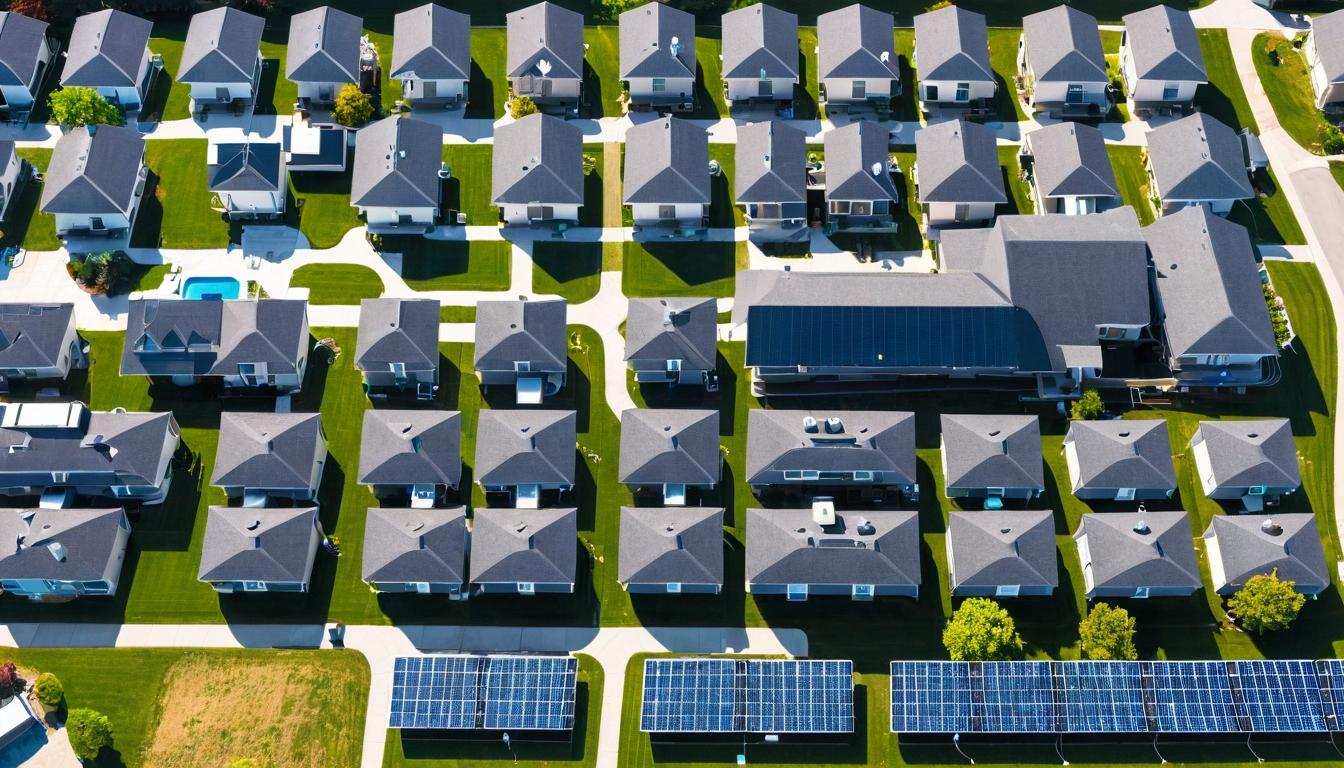
The sun doesn't charge for its energy, but harnessing it has become one of the most complex political and technological puzzles of our time. While solar panels now grace millions of American rooftops, the real story isn't in the gleaming silicon surfaces—it's in the backroom negotiations, the landfill calculations, and the quiet revolution happening in America's heartland.
Walk through any suburban neighborhood today and you'll see the evidence: solar arrays spreading like technological ivy across rooftops. But what most homeowners don't see are the battles being fought at utility commission hearings across the country. Net metering—the policy that allows solar owners to sell excess power back to the grid—has become the new frontline in the energy wars. In states from California to Florida, utilities are pushing for changes that could make rooftop solar less economical, arguing that solar homeowners aren't paying their fair share for grid maintenance. Meanwhile, solar advocates counter that distributed generation actually strengthens the grid and delays costly infrastructure upgrades.
Beneath these policy skirmishes lies a more fundamental shift: solar is no longer just a coastal phenomenon. The Midwest, once considered solar's final frontier, is now experiencing its own renewable renaissance. Farmers in Iowa and Ohio are discovering that leasing land for solar farms can provide more stable income than volatile crop prices. Community solar projects are allowing renters and low-income households to participate in the energy transition for the first time. This isn't just about clean energy—it's about economic resilience in regions that have watched manufacturing jobs disappear for decades.
But as the industry celebrates record installations, a darker question looms: what happens to all these panels in 25 years? The first generation of solar installations is approaching retirement age, and the recycling infrastructure simply doesn't exist at scale. Most panels end up in landfills, where their valuable materials—silver, silicon, copper—are lost forever. A handful of startups are trying to change this, developing processes to recover up to 95% of a panel's materials, but they're operating in a policy vacuum. Without mandatory recycling programs or extended producer responsibility laws, the solar industry risks creating its own environmental crisis.
The technology itself is undergoing quiet revolutions that most consumers never see. Bifacial panels—which capture light on both sides—are boosting output by 10-20% without requiring more space. Perovskite solar cells, once confined to laboratory demonstrations, are finally approaching commercial viability with stability improvements that could make them the iPhone to silicon's flip phone. Even mounting systems are getting smarter, with trackers that follow the sun's path and floating solar arrays that reduce water evaporation in drought-prone regions.
Perhaps the most surprising development is how solar is reshaping America's relationship with energy storage. The old model of building power plants to meet peak demand is being replaced by distributed networks of solar-plus-storage systems that can island themselves during outages. In Puerto Rico after Hurricane Maria, and in California during wildfire-related blackouts, solar and batteries kept lights on when the centralized grid failed. This isn't just backup power—it's a fundamental rethinking of what resilience means in an era of climate disruption.
Yet for all this progress, equity remains solar's unfinished business. While white households adopt solar at nearly twice the rate of Black households, new financing models and community-led initiatives are beginning to close the gap. Solar cooperatives in Baltimore, workforce development programs in Oakland, and specialized lending products are proving that the energy transition doesn't have to leave anyone behind. The most innovative policies aren't coming from Washington—they're emerging from city councils and community organizations that understand their neighborhoods' unique needs.
What emerges from these interconnected stories is a picture of an industry at a crossroads. Solar has moved from fringe to mainstream, but with that success comes new responsibilities and challenges. The panels on your roof are connected to global supply chains, local politics, environmental calculations, and technological breakthroughs happening in labs you'll never visit. The sunlight may be free, but building a system that captures it fairly, efficiently, and sustainably requires the kind of complex human ingenuity that no panel can manufacture.
The solar revolution's hidden battles: From rooftop politics to recycling nightmares