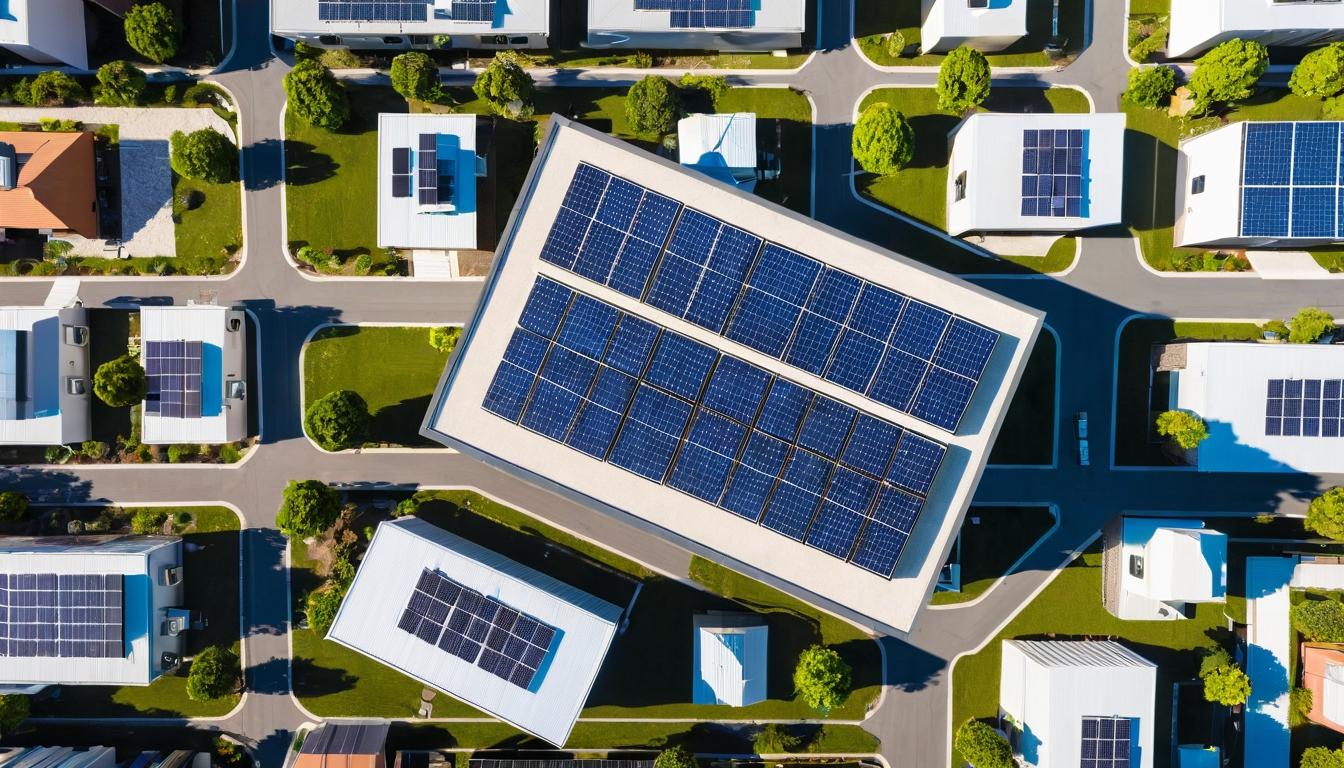
If you think solar panels are just shiny rectangles soaking up sun on suburban rooftops, you're missing the real story. There's a quiet revolution happening—one that's reshaping energy markets, challenging utility monopolies, and creating opportunities most homeowners haven't even considered. This isn't about environmental virtue signaling; it's about hard economics, technological innovation, and a fundamental shift in who controls power—literally.
Walk through any neighborhood with solar installations, and you'll notice something curious: the panels all look roughly the same. But beneath those uniform surfaces, a technological arms race is raging. Manufacturers are pushing efficiency boundaries with perovskite tandem cells that could soon break the 30% efficiency barrier—a number that seemed like science fiction just five years ago. Meanwhile, bifacial panels are capturing sunlight from both sides, while microinverters at each panel are eliminating the single-point failures that plagued earlier systems. The hardware is getting smarter, more resilient, and surprisingly more beautiful, with solar shingles that blend seamlessly into rooflines.
But here's what most installers won't tell you: the real action isn't on your roof—it's in your utility's accounting department. Net metering, the policy that lets solar owners sell excess power back to the grid, is under attack in state after state. Utilities are pushing for new fees and reduced compensation rates, arguing that solar homeowners don't pay their fair share for grid maintenance. What they're not saying is that distributed solar actually reduces strain on aging infrastructure during peak demand hours. The battle over net metering isn't about fairness; it's about control over a decentralized energy future.
Speaking of control, have you checked your solar monitoring app today? Modern systems don't just produce power—they communicate, self-diagnose, and even predict maintenance needs. Artificial intelligence algorithms now optimize panel angles in real-time, while blockchain-enabled peer-to-peer energy trading lets neighbors buy and sell electrons without middlemen. In Brooklyn, a microgrid experiment allows solar-equipped brownstones to share power during blackouts, creating resilient communities that laugh at utility outages. This isn't futuristic speculation; it's happening now in pilot projects across the country.
Then there's the recycling problem nobody wants to talk about. With first-generation solar panels reaching end-of-life, we're facing a tidal wave of electronic waste. Current recycling rates hover around 10%, and most processes recover only the aluminum frames and glass. The valuable silicon, silver, and rare earth elements? Mostly landfilled. But innovators are developing chemical processes that recover 95% of materials at competitive costs, while some manufacturers are designing panels for easy disassembly from the start. The circular solar economy isn't just environmentally necessary—it's becoming economically inevitable.
Perhaps most surprisingly, solar is democratizing energy in ways that defy traditional economics. Community solar gardens let renters and low-income households buy into shared arrays, while solar-as-a-service models eliminate upfront costs entirely. In historically marginalized communities from Baltimore to Oakland, solar cooperatives are training local installers and keeping energy dollars circulating locally. The energy transition isn't just about megawatts; it's about who benefits from those megawatts.
So what's the catch? Interconnection queues. As solar adoption accelerates, utilities are overwhelmed with applications to connect new systems to the grid. Wait times stretching to eighteen months aren't uncommon, creating a bottleneck that threatens to stall the entire transition. Some states are experimenting with automated approval for smaller systems, while others are investing in grid modernization to handle the influx. The solution will require regulatory creativity and utility cooperation—neither known for moving quickly.
Meanwhile, the financial landscape keeps evolving. Solar panel prices have dropped 90% in the past decade, but installation labor costs haven't followed. New mounting systems that snap together like Legos and drone-assisted site surveys are beginning to change that equation. More significantly, solar-plus-storage systems now qualify for the same 30% federal tax credit as panels alone, making battery backup suddenly affordable for middle-class homeowners. The economics keep improving, but you need to read the fine print—especially with constantly changing incentives.
Look beyond the residential sector, and you'll find solar popping up in unexpected places: floating on reservoirs to reduce evaporation, integrated into highway noise barriers, even woven into agricultural fields in 'agrivoltaic' systems that grow crops under partially shaded panels. The most promising development might be building-integrated photovoltaics—solar cells embedded directly into windows, facades, and roofing materials. When every sun-facing surface becomes a power generator, we'll stop talking about 'solar installations' and start talking about 'buildings.'
What does all this mean for you? If you're considering solar, look beyond the upfront cost. Consider battery backup for resilience, research your utility's net metering future, and think about how long you'll stay in your home. If you already have panels, explore adding storage or joining a virtual power plant program that pays you for grid services. And if you think solar isn't for you? Look again—the technology, economics, and policies are changing faster than anyone predicted. The energy revolution isn't coming; it's already on your roof, in your neighborhood, and rewriting the rules of power itself.
The hidden revolution: how solar panels are quietly transforming everything from your roof to the grid