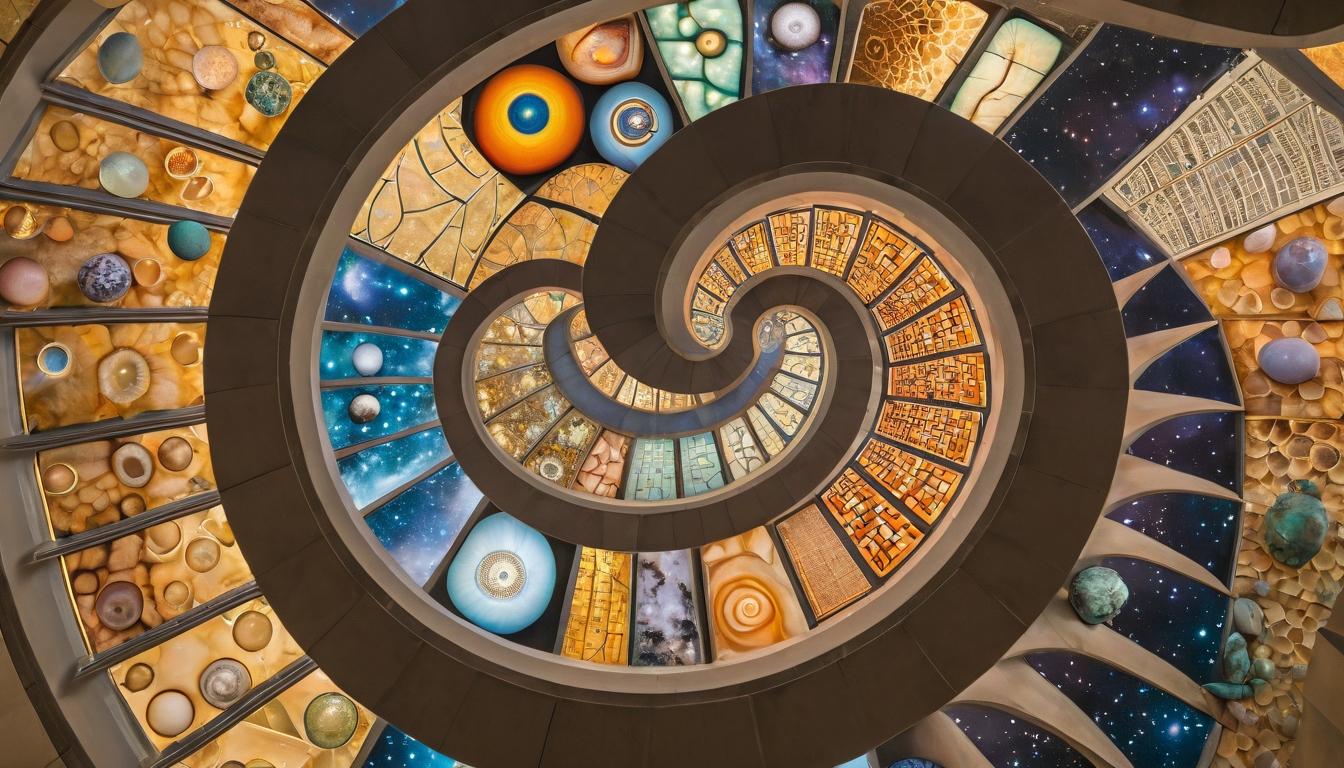
Walking through the ancient temples of Egypt or studying the intricate patterns of Gothic cathedrals, one can't help but notice the recurring geometric motifs that seem to whisper secrets across millennia. These aren't mere decorative flourishes—they're the fingerprints of a universal language that connects mathematics, nature, and human consciousness in ways modern science is only beginning to understand.
Sacred geometry represents the mathematical patterns that form the fundamental templates of life itself. From the spiral of a nautilus shell to the hexagonal structure of snowflakes, these shapes appear throughout nature with such consistency that they can't be coincidental. The golden ratio, approximately 1.618, appears in everything from the proportions of the human body to the arrangement of sunflower seeds and the spiral arms of galaxies.
What makes these patterns truly fascinating isn't just their mathematical perfection, but their psychological and spiritual impact on human beings. Studies in environmental psychology have shown that people consistently prefer spaces and objects that incorporate these sacred proportions. When we encounter the golden ratio in architecture or art, something deep within us responds—a resonance that transcends cultural boundaries and personal preferences.
Modern neuroscience is beginning to uncover why these patterns affect us so profoundly. Brain imaging studies reveal that geometric patterns activate specific neural pathways associated with pattern recognition, aesthetic appreciation, and even states of meditation. The mandala, a circular geometric configuration of symbols used in Hinduism and Buddhism, has been shown to induce calm states and enhance focus in clinical settings.
The Flower of Life pattern, consisting of multiple evenly-spaced, overlapping circles arranged in a flower-like pattern, appears in ancient sites across the globe—from the Temple of Osiris in Egypt to Chinese temples and medieval churches. This universal appearance suggests that ancient civilizations independently discovered these fundamental patterns and recognized their significance.
Contemporary researchers are exploring how these geometric principles might explain consciousness itself. The holographic principle in theoretical physics suggests that our three-dimensional reality might be projected from two-dimensional information, much like how a hologram works. If consciousness arises from the fundamental geometry of spacetime, as some physicists propose, it would explain why geometric patterns resonate so deeply with our perception of reality.
Practical applications of sacred geometry are emerging in surprising fields. Architects are rediscovering how to design buildings that promote wellbeing using these ancient principles. Healthcare facilities incorporating sacred geometry report faster patient recovery times, while offices designed with these patterns show increased productivity and reduced stress among workers.
The relationship between geometry and sound reveals another layer of this mystery. Cymatics—the study of visible sound and vibration—shows how specific frequencies create geometric patterns in materials like sand or water. The same patterns found in sacred geometry emerge when certain tones are played, suggesting a fundamental connection between vibration, form, and consciousness.
Ancient wisdom traditions understood this connection intuitively. Tibetan monks creating sand mandalas or Islamic artists designing intricate geometric patterns weren't merely creating art—they were mapping the architecture of consciousness itself. Their work represents centuries of observational science about how specific patterns affect human awareness and spiritual experience.
As quantum physics continues to reveal the strange, non-local connections between particles across vast distances, the idea that consciousness might be fundamentally geometric becomes less far-fetched. The universe appears to be built on mathematical principles, and our minds appear uniquely equipped to recognize and respond to these underlying patterns.
Perhaps the most compelling evidence for the power of sacred geometry comes from personal experience. Next time you find yourself in a cathedral, looking at a snowflake, or simply observing the branching patterns of trees, pay attention to how these forms make you feel. That sense of harmony and rightness isn't accidental—it's the universe speaking in its native tongue, and something within us understands the language perfectly.
The hidden science behind sacred geometry and consciousness