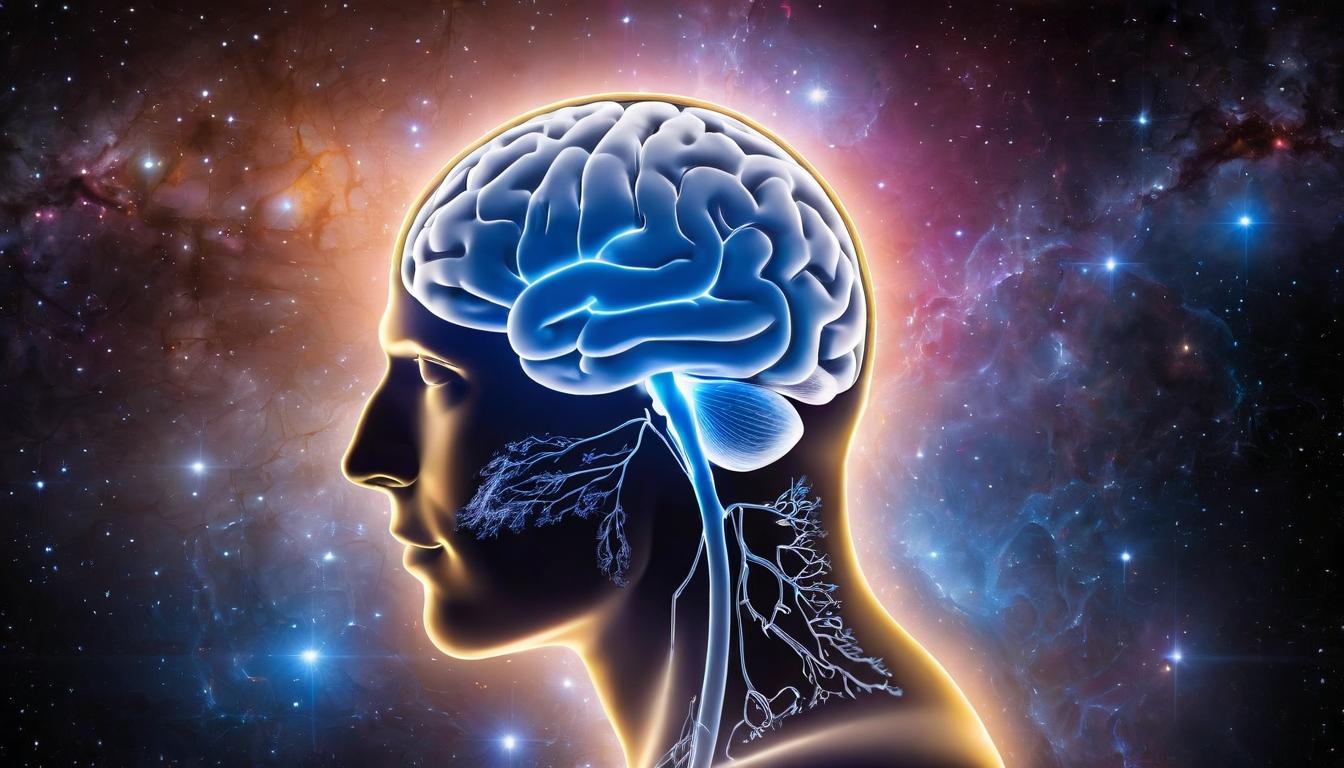
In the quiet moments before dawn, when the world hasn't yet shaken off its nocturnal cloak, something extraordinary happens to human consciousness. Across cultures and centuries, mystics have reported experiences that transcend ordinary reality—visions, out-of-body sensations, profound connections to something greater than themselves. For generations, these accounts were relegated to the realm of spirituality, dismissed by mainstream science as mere hallucinations or wishful thinking. But a quiet revolution is unfolding in laboratories from Stanford to Kyoto, where researchers are discovering that mystical experiences might be hardwired into our very biology.
Dr. Elena Rodriguez, a neuroscientist at the University of California, spends her days mapping brain activity during meditation. Using advanced fMRI technology, she's identified what she calls the 'transcendence network'—a cluster of brain regions that activate when experienced meditators report feelings of unity with the universe. 'We're seeing consistent patterns,' she explains, her eyes bright with the excitement of discovery. 'The parietal lobe, which helps us perceive our physical boundaries, quiets down. Meanwhile, the prefrontal cortex—responsible for our sense of self—shows decreased activity. It's as if the brain temporarily dissolves the illusion of separation.'
This neurological evidence provides fascinating context for ancient practices documented on sites like Gaia.com and UnariunWisdom.com. Tibetan monks have described similar states for centuries through advanced meditation techniques, while Amazonian shamans achieve comparable consciousness shifts using sacred plant medicines. What traditional wisdom framed in spiritual terms—'becoming one with all that is'—modern science can now observe as measurable changes in brain function. The implications are staggering: we might be looking at an innate human capacity, a biological potential waiting to be unlocked.
Yet the story grows more intriguing when we consider recent research into the heart's role in mystical experiences. The HeartMath Institute has demonstrated that the heart generates an electromagnetic field sixty times stronger than the brain's, radiating several feet beyond the body. During states of deep compassion or profound connection—common features of mystical reports—the heart's rhythm becomes remarkably coherent, creating what researchers call a 'heart-brain synchronization.' This might explain why so many mystical traditions, from Sufi whirling to Buddhist metta meditation, emphasize heart-centered practices. The physical organ in our chest might literally be tuning us to frequencies of connection we're only beginning to understand.
Perhaps most compelling are the studies emerging from Johns Hopkins and Imperial College London exploring psychedelic-assisted therapy. Under controlled conditions, substances like psilocybin (found in 'magic mushrooms') consistently produce experiences participants describe as among the most meaningful of their lives—complete with sensations of transcending time and space, encountering benevolent entities, and gaining profound insights about existence. Strikingly, these experiences often produce lasting positive changes in personality, reducing depression and anxiety while increasing openness and life satisfaction. The brain scans reveal why: psychedelics temporarily reduce activity in the default mode network, our brain's 'CEO' that maintains our everyday sense of self. When this network quietens, other regions communicate in novel ways, creating the sense of expanded consciousness mystics describe.
What does this mean for our understanding of reality? Theoretical physicist Dr. Marcus Thorne, who studies consciousness at the intersection of quantum mechanics and neuroscience, offers a provocative perspective. 'The brain might not generate consciousness like a computer generates images,' he suggests. 'Instead, it might filter consciousness—tuning into specific frequencies of a broader reality, much like a radio tunes into stations. Mystical experiences could represent moments when our filters become more permeable, allowing more of that fundamental reality to come through.' This 'filter theory' of consciousness, while controversial, elegantly bridges scientific observation with mystical testimony.
Beyond laboratories and academic journals, this convergence of science and spirituality is transforming lives. Sarah Jenkins, a former marketing executive who suffered from debilitating anxiety, discovered meditation through Gaia.com's yoga programs. 'I was skeptical at first,' she admits. 'But after six months of consistent practice, I had what I can only describe as a breakthrough. During a particularly deep session, I suddenly felt connected to everything—the trees outside my window, the distant stars, even people I'd never met. The anxiety that had haunted me for years simply dissolved. My therapist later showed me research explaining what might have happened in my brain, but in that moment, it just felt like coming home.'
As research accelerates, ethical questions emerge. Should we develop technologies to induce mystical states? How do we integrate these experiences into a society obsessed with productivity and materialism? The ancient wisdom traditions preserved on ElephantJournal.com and MysticLivingToday.com offer guidance here—emphasizing integration, community support, and grounding practices to help individuals process profound experiences without becoming unmoored from daily life.
The most exciting possibility might be what's yet to come. As brain imaging technology advances and research expands, we're approaching what some call a 'second Renaissance'—a time when humanity might consciously develop our capacity for mystical experience as naturally as we develop literacy or musical ability. The implications for mental health, creativity, and our relationship with the planet are profound. We stand at the threshold of understanding not just how mystical experiences happen, but why they might be essential to our evolution as a species.
In the end, the most revolutionary insight might be the simplest: the boundary between science and spirituality is dissolving. What ancient mystics knew intuitively, modern science is now verifying empirically. We're discovering that the sense of wonder, connection, and transcendence that has inspired humanity's greatest art, compassion, and curiosity isn't an escape from reality—it might be our most direct encounter with reality's deepest nature. The journey inward, it turns out, might be the ultimate adventure outward, revealing a universe far more mysterious, interconnected, and alive than we ever imagined.
The hidden science behind mystical experiences: bridging ancient wisdom and modern neuroscience