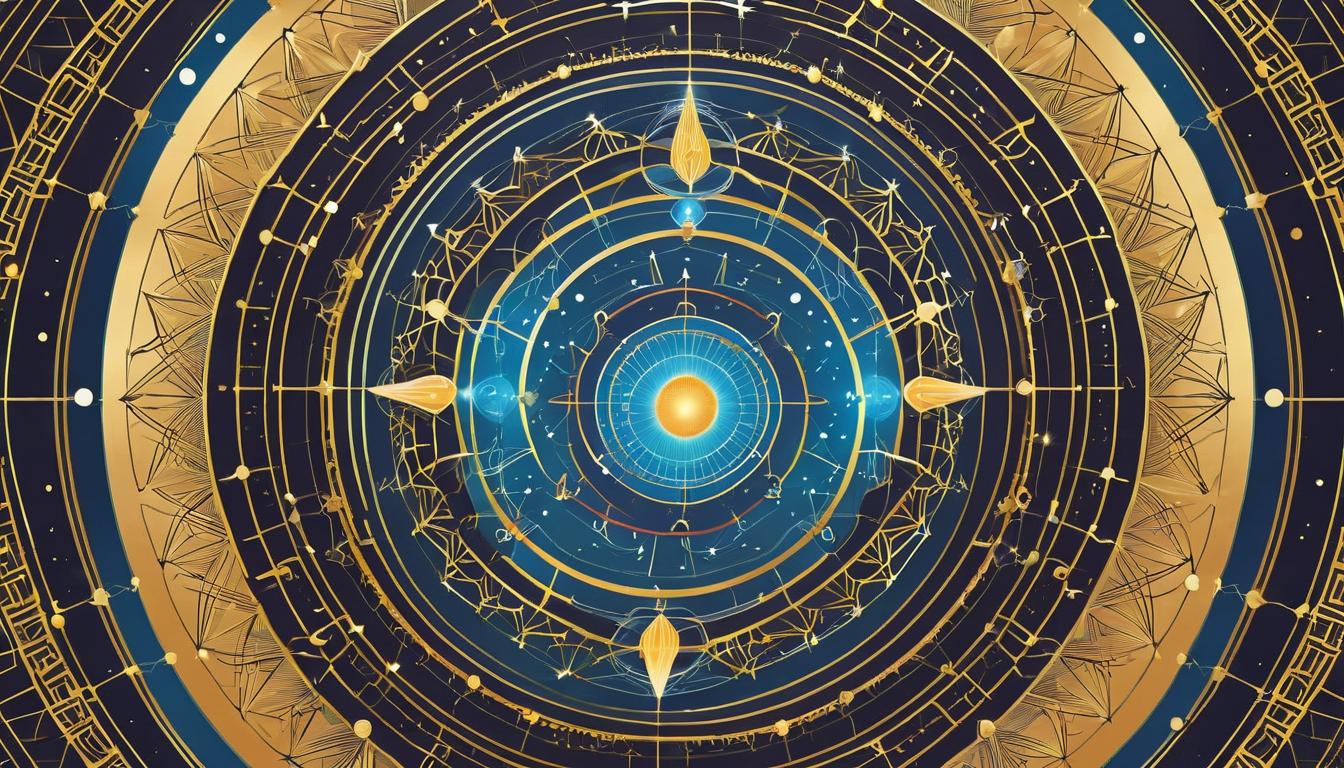
In the quiet spaces between breaths, there exists a geometry most never perceive—a subtle architecture of consciousness that weaves through our daily lives like invisible threads. Across platforms like Gaia, Elephant Journal, and Mystic Living Today, seekers are piecing together a startling realization: the mystical isn't some distant realm of chanting monks and incense smoke, but a living, breathing pattern language embedded in everything from quantum physics to the rhythm of our own heartbeats. This isn't about escaping reality, but learning to read its deeper syntax.
What if synchronicity—those 'meaningful coincidences' that websites like Higher Perspectives often explore—isn't random at all, but evidence of this underlying order? Researchers in fields from neuroscience to ecology are beginning to document what mystics have whispered for centuries: that nature, mind, and cosmos communicate through a shared set of forms and frequencies. The spiral of a galaxy, the branching of a tree, the neural pathways in your brain—they're not just metaphorically similar, but mathematically related expressions of the same creative principle.
This geometric lens transforms how we understand healing and personal growth, topics central to Gaiam and Unariun Wisdom. Trauma isn't just a psychological event—it's a distortion in our energetic geometry, a kink in the pattern. Practices like meditation, breathwork, or mindful movement don't just 'calm us down'; they gently coax our personal energy field back into its natural, coherent shape. The ancient concept of 'sacred geometry' suddenly becomes practical: certain shapes and proportions literally resonate with our biology, promoting states of harmony and clarity.
Yet this isn't merely an individual pursuit. The real investigation leads to a provocative question: if consciousness has geometry, what patterns are we collectively creating? Every thought, emotion, and intention contributes to a shared energetic landscape. The divisive anger on social media, the collective hope during a crisis—these aren't abstract concepts, but tangible forces that ripple through this subtle matrix. Understanding this gives new urgency to the call for mindful living; we're not just working on ourselves, but participating in the very fabric of reality.
The most compelling evidence often comes from the edges of science. Studies in quantum entanglement suggest particles can communicate instantaneously across vast distances, defying classical physics. What if this 'spooky action at a distance' is the physical echo of consciousness's non-local nature? Pioneers at institutions exploring consciousness research are mapping how intention can influence physical systems, providing data points for what was once purely mystical intuition. The line between observer and observed is blurring, revealing a participatory universe.
So where does this leave us, the modern seeker navigating between ancient wisdom and cutting-edge science? It invites a new kind of literacy. Learning to perceive these patterns means paying attention differently—noticing the recurring numbers, the dreams that echo waking events, the sudden insights that arrive during a walk in the woods. It means cultivating what some traditions call the 'witness mind,' a state of relaxed awareness where the hidden architecture of experience begins to reveal itself.
This journey into the geometry of consciousness isn't about finding definitive answers, but about asking better questions. It's an open investigation, one that bridges the heartfelt personal explorations of Elephant Journal with the cosmic scale of Gaia's documentaries. As we learn to read these subtle patterns, we may discover that the most profound mysteries aren't 'out there' to be solved, but living patterns within and around us, waiting to be recognized and engaged with conscious, creative intent.
The hidden geometry of consciousness: mapping the unseen patterns that shape reality