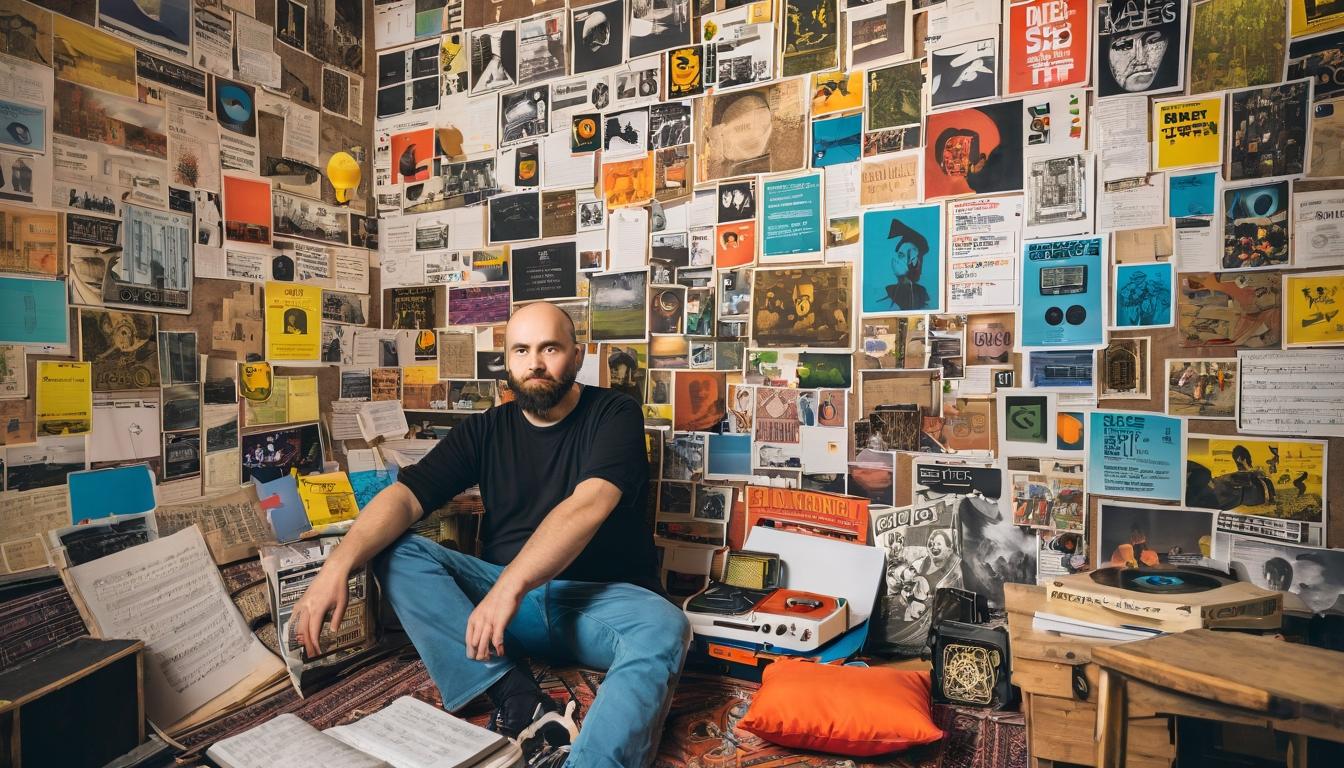
In the shadow of streaming charts and viral TikTok moments, a quiet revolution is brewing. While major platforms push cookie-cutter playlists and recycled trends, a network of artists from São Paulo to Seoul are building new sonic languages that defy categorization. These aren't the sounds you'll find topping Spotify's Global 50—they're the raw materials for what comes next, circulating on niche platforms and in encrypted group chats long before reaching editorial playlists.
Take the phenomenon of 'deconstructed club' meeting traditional folk instrumentation in Eastern Europe. In Warsaw basements and Bucharest warehouses, producers are slicing Balkan brass samples with granular synthesis, creating rhythmic patterns that feel simultaneously ancient and alien. This isn't mere fusion—it's systematic deconstruction, with artists like Romania's Katarina Gryvul and Poland's Jacek Sienkiewicz treating cultural heritage as source code to be rewritten.
Meanwhile, across the Atlantic, a different kind of underground economy thrives. In Los Angeles' Highland Park neighborhood and Brooklyn's Ridgewood, cassette labels and DIY venues operate on barter systems and community trust. Here, success isn't measured by monthly listeners but by sustainable ecosystems. The artist who pressed 100 tapes that sold out through word-of-mouth holds more cultural capital than the major-label act with millions of passive streams. These micro-economies prove that music can thrive outside attention markets.
The most fascinating development might be what's happening beneath the algorithms themselves. A new generation of producers has begun 'algorithm-gaming' as artistic practice—not for viral success, but for subversion. They're creating tracks designed to confuse recommendation engines, embedding ultrasonic frequencies that affect playback systems, or structuring songs with intentionally misleading metadata. Berlin collective OOF calls this 'platform critique as performance,' turning the tools of musical surveillance into instruments themselves.
Perhaps the most significant shift is geographical. For decades, music innovation flowed from established centers—London, New York, Berlin. Today, the most exciting developments emerge from what music journalist Chal Ravens calls 'the overlooked peripheries.' Lisbon's batida scene fuses African diaspora rhythms with experimental electronics. Nairobi's underground blends gengetone with industrial noise. Santiago de Chile's young composers are reimagining Andean instruments through modular synthesizers. These scenes aren't looking to the traditional hubs for validation—they're building self-sufficient creative ecosystems.
What unites these disparate movements is a shared rejection of passive consumption. The artists leading them create not just music, but contexts—elaborate mythologies, alternative distribution networks, and new models for collaboration. They're proving that in an age of musical abundance, scarcity of meaning becomes the ultimate currency. The future of music isn't in louder drops or catchier hooks, but in deeper connections—between sounds, between communities, between past and future.
This underground renaissance suggests we're entering music's most creatively democratic era. When a teenager in Manila can upload a track blending kulintang percussion with hyperpop aesthetics directly to a global audience, geography ceases to dictate influence. When artists in Tehran develop entire genres through encrypted file-sharing, censorship loses its power. The result isn't homogenization, but unprecedented diversity—a thousand flowers blooming in the cracks of the attention economy.
The revolution won't be algorithmically optimized. It's happening in the margins, in the glitches, in the spaces between genres and geographies. And it sounds like nothing you've heard before.
The underground sounds reshaping mainstream music while algorithms sleep