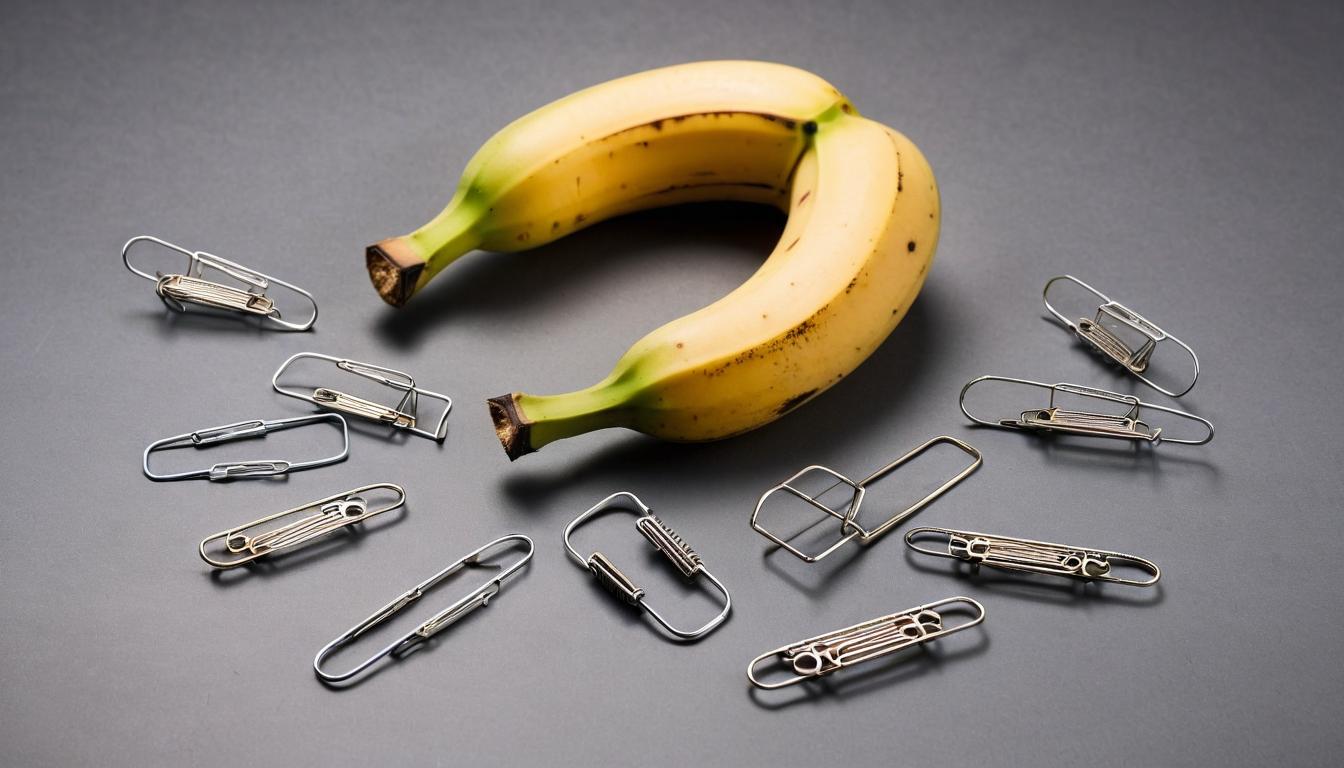
You've probably never given much thought to the humble paperclip. It's just a bent piece of wire that holds papers together, right? But what if I told you that during World War II, Norwegian resistance fighters wore paperclips on their lapels as a silent protest against Nazi occupation? The simple office supply became a symbol of unity and resistance—a fact that transforms this mundane object into something quietly heroic. The paperclip's inventor, Johan Vaaler, never actually patented the design we use today; that version came later from the Gem Manufacturing Company. Yet Vaaler's original concept sparked a revolution in office organization that continues nearly 130 years later.
Consider the banana—that cheerful yellow fruit you might have eaten this morning. Its journey to your kitchen is stranger than fiction. The bananas your grandparents ate were an entirely different variety called Gros Michel, which dominated the market until a fungal disease called Panama disease wiped out plantations in the 1950s. The Cavendish banana replaced it, but now it too faces extinction from a new strain of the same disease. What's more, bananas are technically berries, while strawberries aren't. Nature has a peculiar sense of humor when it comes to classification.
Let's talk about something that follows you everywhere: dust. That fine layer settling on your furniture isn't just dead skin cells—though those do make up a portion. Household dust is a microscopic museum of your environment. It contains textile fibers from your clothes, pollen from nearby plants, soil particles tracked indoors, and even tiny fragments of meteorites that have fallen to Earth. In fact, scientists estimate that about 5,000 tons of cosmic dust rain down on our planet each year. The next time you wipe a surface, you're clearing away stardust alongside the ordinary grime.
The history of common objects often reveals unexpected connections. Take the microwave oven, for instance. It was invented entirely by accident in 1945 when engineer Percy Spencer noticed a candy bar melting in his pocket while testing radar equipment. The magnetron tube he was working with emitted microwaves that heated the chocolate. Within a year, Raytheon filed a patent for the first microwave oven, which stood nearly six feet tall and weighed over 750 pounds. Today's countertop versions are descendants of that serendipitous discovery—proof that innovation sometimes comes from paying attention to unexpected side effects.
Even something as simple as a pencil has layers of hidden complexity. The average pencil can draw a line about 35 miles long or write approximately 45,000 words. That graphite core isn't actually lead—it's a mixture of graphite and clay, a formulation perfected by Nicolas-Jacques Conté in 1795 after France's graphite supply was cut off during the Napoleonic Wars. The yellow pencil became standard thanks to an American company that wanted to associate their product with luxury, using a color connected to Chinese royalty. Every time you write with a pencil, you're participating in a tradition shaped by war, marketing, and material science.
Consider the zipper, that ingenious fastener on your jacket or jeans. It took over twenty years to become commercially viable after its initial patent in 1851. Early versions were clumsy and frequently jammed, earning the nickname 'the clasp locker.' The modern zipper only gained popularity when the B.F. Goodrich Company used it on rubber boots in the 1920s, coining the name 'zipper' from the sound it made. Before that, people relied on buttons, hooks, or laces—all more time-consuming to fasten. The zipper's success demonstrates how persistence and rebranding can turn a struggling invention into an everyday essential.
What about the tea bag? It was another accidental invention, created when New York merchant Thomas Sullivan sent tea samples in small silk bags to customers in 1908. Instead of removing the leaves, recipients steeped the entire bag, finding it convenient. Sullivan noticed and began producing bags specifically for brewing. Today, approximately 96% of tea consumed in the United Kingdom is brewed using tea bags—a testament to how small mistakes can reshape cultural habits.
These stories remind us that ordinary items carry extraordinary histories. They've survived wars, adapted to crises, and transformed through chance discoveries. The next time you use a paperclip, eat a banana, or zip up a jacket, remember: you're interacting with artifacts of human ingenuity, each with a backstory more fascinating than its simple function suggests.
The hidden world of everyday objects: surprising stories behind things you thought you knew