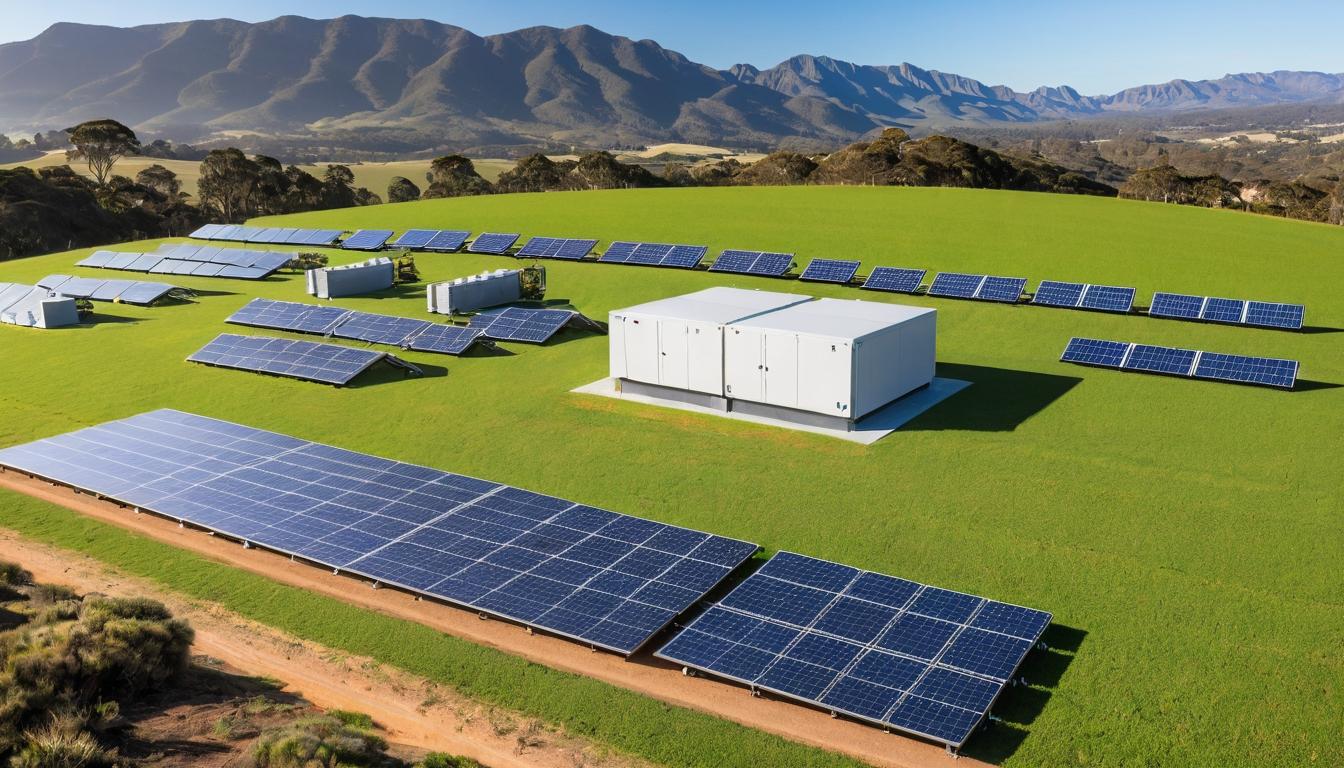
If you think about the energy transition, you probably picture solar panels gleaming on rooftops or wind turbines spinning gracefully on distant hills. But there's a quieter revolution happening in warehouses, industrial parks, and even underground caverns—one that might ultimately prove more transformative than any renewable installation. Energy storage, once considered a niche technology, is becoming the silent orchestrator of our power systems, and the implications are staggering.
Walk into any utility control room today, and you'll see operators staring at screens that look more like air traffic control displays than traditional power grid monitors. They're not just managing generation and consumption anymore—they're juggling electrons across time. That battery installation in Texas isn't just storing solar power for nighttime use; it's providing milliseconds of stability when a cloud passes over a major solar farm. That pumped hydro facility in the mountains isn't just a giant battery; it's a financial instrument, buying cheap power and selling it when prices spike.
What makes this shift particularly fascinating isn't the technology itself—though lithium-ion batteries have improved dramatically—but how it's changing the fundamental economics of electricity. For decades, power was a just-in-time commodity: you generated it exactly when needed. Storage introduces the radical concept of 'just-in-case' power, creating what one grid operator described to me as 'temporal arbitrage opportunities' that would make Wall Street traders blush.
Consider what's happening in California, where storage is becoming the Swiss Army knife of grid management. During last year's heat waves, batteries didn't just provide emergency power—they allowed utilities to avoid firing up the dirtiest, most expensive 'peaker' plants. They're smoothing out the duck curve (that dramatic dip and spike in net demand as solar comes online and then drops off) so effectively that some experts believe we might need to rename it. The duck, it seems, is learning to swim.
But here's where the story gets really interesting: storage is creating strange new alliances and conflicts. Traditional utilities that once viewed batteries as threats to their business models are now racing to build their own storage fleets. Oil and gas companies are investing in storage startups. Even tech giants are getting in on the action, with data center operators realizing that on-site storage can provide both backup power and revenue from grid services.
Meanwhile, a quieter battle is brewing over who controls these assets. Should storage be centralized in utility-scale installations, or distributed across millions of homes and businesses? The answer could determine whether we end up with a more democratic energy system or simply reinforce existing power structures. In Australia, where home batteries have proliferated, some neighborhoods have effectively become virtual power plants—but they're still figuring out how to share the benefits fairly.
Then there's the environmental paradox: storage enables more renewables, but manufacturing batteries requires mining lithium, cobalt, and other materials with their own ecological and human costs. The industry is racing to develop alternatives—from flow batteries using abundant materials to gravity-based systems in abandoned mines—but for now, we're trading one set of environmental challenges for another.
Perhaps most surprisingly, storage is changing how we think about energy security. For years, the focus was on securing fuel supplies—oil tankers, gas pipelines, coal trains. Now, security means protecting control systems from cyberattacks, ensuring supply chains for critical minerals, and maintaining manufacturing capacity. When Texas froze in 2021, the conversation wasn't just about gas wells; it was about why storage couldn't fill the gap.
As I toured a massive battery installation outside Phoenix recently, the site manager pointed to rows of containers that looked like shipping crates. 'Each one of these can power about a thousand homes for four hours,' he said. 'But that's not really the point anymore. The point is that we can turn sunlight from noon into electricity for dinner, and wind from midnight into power for breakfast. We're not just storing energy—we're storing time.'
That last insight might be the most profound. For all our technological sophistication, humanity has never been good at storing energy at scale. We've burned wood when we had it, pumped oil when we found it, built dams when the geography allowed. Storage represents something new: the ability to decouple energy from its moment of creation. It's allowing us to finally harness the intermittent abundance of sun and wind, not as supplemental power sources, but as foundational ones.
What happens next will depend on regulations, markets, and technology—but mostly on imagination. Will we use storage to create more resilient communities, or simply to optimize corporate profits? Can we build systems that share benefits broadly, or will storage become another tool for entrenching inequality? The batteries themselves don't care; they just store and release electrons. It's up to us to decide what kind of future we're charging up for.
The hidden grid: How energy storage is quietly rewriting the rules of power