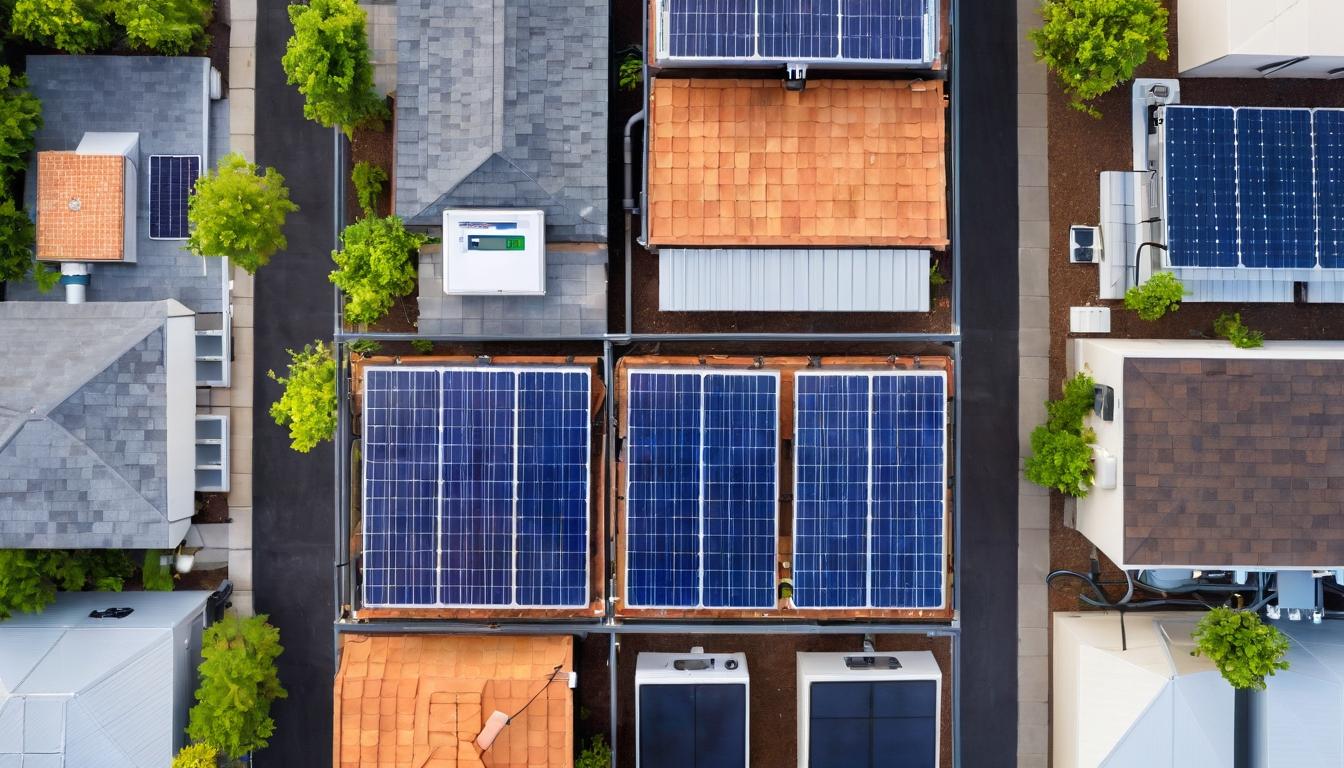
In the shadow of towering transmission lines and century-old power plants, a quiet revolution is unfolding across America's energy landscape. While headlines fixate on massive offshore wind farms and sprawling solar arrays, the real transformation is happening at the neighborhood level—on rooftops, in parking lots, and behind suburban fences. This isn't just about clean energy; it's about who controls power in the most literal sense.
Walk through any American suburb today, and you'll see the evidence: solar panels glinting in the sun, electric vehicles charging in driveways, home batteries tucked discreetly beside air conditioning units. What looks like individual consumer choices is actually coalescing into something far more significant—a distributed energy resource (DER) network that's beginning to function like a virtual power plant. Utilities are watching with a mixture of fascination and anxiety as their traditional one-way power flow model gets turned inside out.
California offers the most dramatic case study. During last year's heat waves, when grid operators feared rolling blackouts, they didn't just fire up peaker plants. They sent signals to thousands of home batteries and smart thermostats, calling on what grid operators now call 'negawatts'—power that doesn't need to be generated because it's being conserved or shifted. The result was enough capacity to power a small city, all orchestrated through software platforms most homeowners never think about.
But this distributed revolution faces a regulatory quagmire. Most state utility commissions are still operating with rules written for the era of centralized power. The battle over net metering—how much utilities pay rooftop solar owners for excess power—has become the frontline in this conflict. In states like Florida and Indiana, utilities have successfully lobbied to slash compensation rates, arguing that solar homeowners aren't paying their fair share for grid maintenance. Solar advocates counter that distributed resources actually reduce strain on the grid during peak hours.
Meanwhile, a new player has entered the arena: the virtual power plant (VPP) aggregator. Companies like Sunrun, Tesla, and startup OhmConnect are signing up homeowners with batteries and smart devices, promising to pay them for access to their stored power during grid emergencies. It's creating strange bedfellows—environmentalists who want cleaner energy partnering with tech companies that see dollar signs in distributed optimization.
The technology enabling this shift is advancing at breakneck speed. Smart inverters on solar systems can now respond to grid signals in milliseconds, providing voltage support that once required expensive substation equipment. Blockchain-enabled microgrids in Brooklyn and Vermont allow neighbors to trade solar power peer-to-peer. And artificial intelligence is getting better at predicting when to store versus when to dispatch power from thousands of scattered resources.
Yet for all the technological promise, human behavior remains the wild card. Early adopters embraced solar for environmental reasons or energy independence. The next wave—the majority needed for true grid transformation—will need simpler value propositions. That's why companies are experimenting with everything from flat monthly 'clean energy' subscriptions to programs that automatically optimize home energy use for both savings and grid support.
Perhaps the most intriguing development is how this distributed energy movement is blurring traditional boundaries. Farmers with methane digesters are becoming power producers. School districts with solar-covered parking lots are turning into mini-utilities. Even electric vehicle batteries, parked 95% of the time, are being tapped as grid assets through vehicle-to-grid (V2G) technology being piloted in Maryland and California.
What's emerging is a more resilient, if more complex, energy system. When Hurricane Ian knocked out power to millions in Florida, homes with solar and batteries became islands of light in a sea of darkness—and in some cases, lifelines for neighbors. This resilience aspect is attracting attention from military bases, hospitals, and data centers that can't afford downtime.
The ultimate question isn't whether distributed energy will grow—that trajectory seems inevitable as costs continue falling. The real uncertainty is how quickly regulations, business models, and social acceptance will evolve to harness its full potential. One thing is clear: the era of passive energy consumers is ending. In its place, we're getting prosumers, micro-entrepreneurs, and a grid that looks less like a hierarchical tree and more like a collaborative network.
As one grid operator quipped recently, 'We used to worry about keeping the lights on. Now we're learning to conduct an orchestra where every instrument can suddenly decide to play a solo.' The music might be unconventional, but it's creating a power system that's more democratic, more resilient, and increasingly powered by the sun on your neighbor's roof rather than the coal in a distant mine.
The hidden grid: how distributed energy is quietly rewriting America's power rules