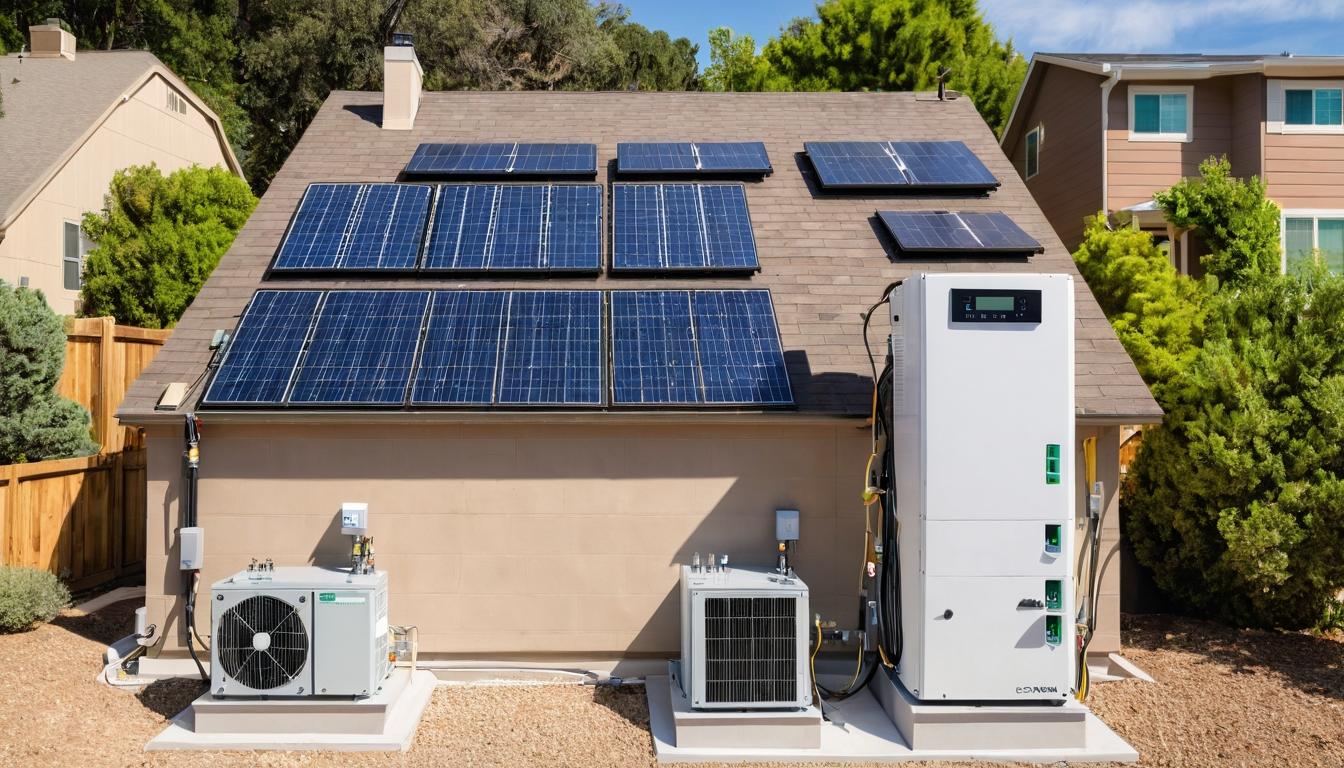
While politicians debate climate bills in Washington and CEOs announce billion-dollar renewable projects, a quieter revolution is unfolding in the most unlikely of places: American basements, attics, and garages. Across the country, homeowners are becoming unwitting participants in a distributed energy war that could reshape our power grid more profoundly than any legislation. This isn't about solar panels on rooftops—though that's part of it—but about how ordinary people are turning their homes into miniature power plants, creating a decentralized network that utilities can't quite control.
In suburban Ohio, a retired engineer named Robert Chen has transformed his basement into what he calls a "microgrid in a box." Stacked against the concrete wall are three Tesla Powerwalls, a small natural gas generator for backup, and an inverter system that lets him sell excess power back to the grid during peak hours. "The utility sends me checks," he says with a grin, showing me his latest statement. "They used to just send bills." Chen is part of a growing movement of "prosumers"—people who both produce and consume energy—who are challenging the century-old utility business model.
Meanwhile, utilities are scrambling to adapt. In California, Pacific Gas & Electric has quietly launched a program that pays homeowners to let the company control their home batteries during grid emergencies. It sounds like a win-win: homeowners get paid, and the utility gets a virtual power plant without building expensive infrastructure. But privacy advocates are raising alarms. "They want access to your energy data, your usage patterns, everything," says energy lawyer Maria Rodriguez. "Once they have that, they can optimize their grid—but they can also optimize their profits at your expense."
This tension between individual empowerment and corporate control is playing out through technology most people don't even know exists. Smart inverters, blockchain-enabled energy trading platforms, and AI-driven home energy management systems are creating what experts call the "energy internet." Just as the internet disrupted media and retail, this network could disrupt energy—if regulators don't stifle it first.
In Texas, where the grid operates independently from the rest of the country, the experiment is already underway. During last winter's freeze, homes with solar and batteries kept the lights on while neighbors shivered in the dark. Now, startups are creating neighborhood microgrids that can disconnect from the main grid entirely. "We're seeing the emergence of energy neighborhoods," explains Dr. Sarah Jensen, an energy researcher at UT Austin. "People are pooling their resources, sharing power, and creating resilience that the centralized grid can't match."
But there's a catch: equity. The upfront costs of batteries and solar panels put this revolution out of reach for low-income households, creating what critics call "energy islands"—wealthy neighborhoods that are self-sufficient while poorer communities remain dependent on an aging grid. Some states are trying to address this through community solar programs, but progress is slow. "We're building two energy Americas," warns community organizer Jamal Williams. "One that's resilient and empowered, and one that's vulnerable and left behind."
Perhaps the most surprising development is who's driving this change. It's not just environmentalists anymore. Preppers concerned about grid collapse, libertarians who distrust big utilities, and tech enthusiasts fascinated by the gadgets are all finding common cause. Their shared belief: the future of energy shouldn't be controlled by a handful of corporations. As Robert Chen in Ohio puts it while showing me his basement setup, "This isn't just about saving money. It's about taking back power—literally."
What happens next depends on regulators, technology costs, and whether utilities fight this trend or embrace it. Some forward-thinking companies are already shifting from selling kilowatt-hours to selling energy services—managing home systems, optimizing usage, and creating new revenue streams. Others are lobbying for rules that would make home energy systems less economical. The battle lines are drawn not in Congress, but in state utility commissions where most people never pay attention.
One thing is clear: the era of passive energy consumption is ending. Whether through choice or necessity, more Americans will become active participants in their energy future. The question isn't whether this distributed revolution will happen, but who will benefit—and who will be left in the dark.
The hidden battle for America's energy future is happening in your basement